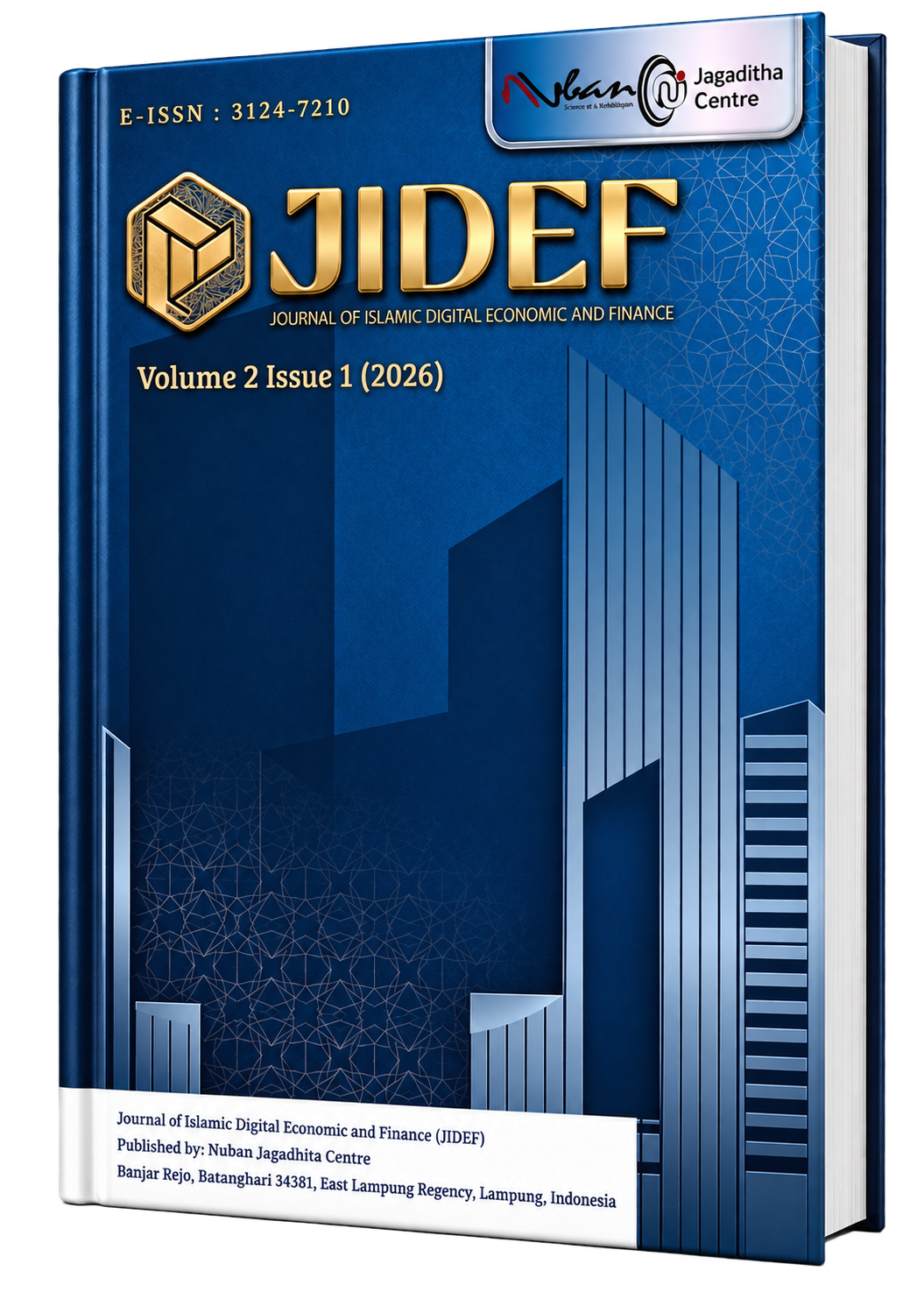
The Impact of Online Loan Traps (P2P Lending Fintech) on Divorce Rates: A Maqashid al-Sharia Approach to Protecting Family Economic Resilience
DOI:
https://doi.org/10.2711/jidef.v2i01.585Keywords:
Divorce vulnerability; Family economic resilience; Maqashid syariah; Online loan debt; P2P lending fintech.Abstract
Objective: This study aims to analyze the relationship between online loan debt, household economic stress, and vulnerability to divorce from the perspective of maqashid syariah. It seeks to explain how the rapid expansion of digital lending services influences family economic resilience and social well-being within the framework of Islamic economics. Method: This study employs a descriptive qualitative approach based on a literature review using content analysis. Data were sourced from regulations, national statistical reports, academic articles, fatwas, and court rulings published online. The analysis was conducted by identifying patterns of argumentation, empirical trends, and conceptual relationships between the development of P2P lending fintech, family economic dynamics, and economic factors contributing to divorce. Relevant literature was further examined through the lens of contemporary maqashid syariah to understand the broader social implications of digital financial practices. Results: The study indicates that ease of access, fast disbursement processes, and low administrative barriers encourage repeated use of digital loans, particularly among households with unstable incomes and limited financial literacy. This pattern has the potential to trigger debt accumulation, financial pressure, psychological stress, a decline in the quality of communication between partners, and an increase in domestic conflict, all of which are associated with heightened vulnerability to divorce. The findings also suggest that excessive dependence on online borrowing may weaken household financial sustainability and undermine long-term family stability. Implication: This study underscores the importance of consumer protection policies that not only focus on cost transparency and data security but also include assessments of repayment capacity, strengthened financial literacy, responsible lending practices, and measures to safeguard family economic resilience. Novelty: This study integrates P2P lending fintech research with studies on family resilience through the lens of Jasser Auda’s contemporary maqashid syariah systems perspective. This study expands the discourse on Islamic economics by positioning the protection of wealth (hifz al-mal) and the protection of family/progeny (hifz al-nasl) as a unified systemic framework for assessing the impact of digital financial innovations.
References
Abdul Ghafar Ismail, & Zulkhibri, M. (2024). Economic capital and risk management in Islamic finance. Routledge.
Ali, S., Simboh, B., & Rahmawati, U. (2023). Determining Factors of Peer-to-Peer (P2P) Lending Avoidance: Empirical Evidence from Indonesia. Gadjah Mada International Journal of Business, 25(1), 1–27. https://doi.org/10.22146/gamaijb.68805
Al-Suwailem, S. (2015). Maqasid al-Shari’ah and Contemporary Islamic Finance: The Role of Mashlahah and Istihsan in Preventing Economic Harms. Islamic Economic Studies, 23(1). https://www.emerald.com/insight/ or Scopus
Ath Thahirah, F., & Kasri, R. A. (2023). Does fintech threaten the performance of Islamic banking in Indonesia? Journal of Islamic Accounting and Finance Research, 5(1), 65–86. https://doi.org/10.21580/jiafr.2023.5.1.13745
Auda, J. (2008). Maqasid al-Shariah as Philosophy of Islamic Law: A Systems Approach. International Institute of Islamic Thought (IIIT).
Azhim, I. K., Natalia, L., Izzati, S. N., & Rizka, F. (2025). Dampak Sosial Ekonomi dari Penggunaan Pinjaman Online Perspektif Maqāṣid al-Syarī‘ah. Al-Fiqh, 3(2), 101–125. https://doi.org/10.59996/al-fiqh.v3i2.791
Badan Pusat Statistik. (2021). Statistik E-Commerce Indonesia 2021.
Bashori, Y. A., Umami, K., & Wahid, S. H. (2024). Maqasid Shariah-Based Digital Economy Model: Integration, Sustainability and Transformation. Malaysian Journal of Syariah and Law, 12(2), 405–425. Scopus. https://doi.org/10.33102/mjsl.vol12no2.647
Dian Sudiantini, Mayang Puspita Ayu, Muhammad Cheirnel All Shawirdra Aswan, Meyliana Alifah Prastuti, & Melani Apriliya. (2023). Transformasi Digital: Dampak, Tantangan, Dan Peluang Untuk Pertumbuhan Ekonomi Digital. Trending: Jurnal Manajemen Dan Ekonomi, 1(3), 21–30. https://doi.org/10.30640/trending.v1i3.1115
Hadiyati, N. (2022). Illegal Fintech P2P Lending in Indonesia: Addressing the Problem of Over-Indebtedness During the COVID-19 Pandemic. Jurnal Jurisprudence, 11(1), 1–16. https://doi.org/https://doi.org/10.23917/jurisprudence.v11i1.14055
Kunaifi, A., & Haq, F. Z. (2025). Is Fintech Financing Failing the Faithful? Online Lending, Debt Culture, and Islamic Economic Principles. EKSYAR: Jurnal Ekonomi Syari’ah & Bisnis Islam, 12(1), 21–33. https://doi.org/10.54956/eksyar.v12i01.672
Linawati, N., Moeljadi, M., Djumahir, D., & Aisjah, S. (2020). The Role of Peer to Peer Lending in Increasing Funding for Micro, Small, and Medium Enterprises. SHS Web of Conferences, 76, 01031. https://doi.org/10.1051/shsconf/20207601031
Mintaryana, N. K. (2025). Pinjaman Online dan Dampaknya terhadap Ekonomi Indonesia: Perspektif Masyarakat. Karimah Tauhid, 4(8), 6210–6218. https://doi.org/10.30997/karimahtauhid.v4i8.20280
Monteiro, A., Cepêda, C., & Silva, A. (2023). Digital Transformation in Companies: A Literature Bibliometric Analysis. 340, 257–267. Scopus. https://doi.org/10.1007/978-981-19-9960-4_23
Mukminati, A. H. (2022). Problematika Hukum Peer To Peer Lending Syariah Di Indonesia. Jurnal Hukum Dan Pembangunan Ekonomi, 10(2), 168–175. https://doi.org/10.20961/hpe.v10i2.64922
Muliatie, Y. E., Arif, M. S., & Sarie, R. F. (2024). Peer-to-Peer Lending Phenomenon in Indonesia. Proceedings of International Conference on Multidiciplinary Research, 6(1), 117–122. https://doi.org/10.32672/picmr.v6i1.1083
Munir, A. (2023). Peer To Peer Lending Analysis Of Sharia Maqashid Perspective. Qawãnïn Journal of Economic Syaria Law, 7(1), 34–67. https://doi.org/10.30762/qaw.v7i1.231
Ningish, P. A., Mukhlisin, M., & Nelli, J. (2022). Family Financial Management in Realizing Sakinah Family. In T. Azid, M. Mukhlisin, & O. Altwijry (Eds), Wealth Management and Investment in Islamic Settings: Opportunities and Challenges (pp. 151–164). Springer Nature. https://doi.org/10.1007/978-981-19-3686-9_10
Nst, A. muda, & Nst, N. (2026). Online Loans in Muslim Families: A Fiqh al-Muamalah Analysis of Debt Responsibility and Family Resilience. Islamic Circle, 7(1), 11–31. https://doi.org/10.56874/islamiccircle.v7i1.3067
Nuh, M., & Muhtadin, S. (2026). Implementation of Husband’s Financial Support for Family Harmony and Stability: Islamic Family Law Perspectives and Digital Era Challenges. Al-Fikru: Jurnal Ilmiah, 20(1), 50–66. https://doi.org/10.51672/alfikru.v20i1.982
Nurapipah, W. A., & Abdullah, M. N. A. (2024). Tabungan Cinta Yang Pecah: Dampak Dan Risiko Perceraian Akibat Pinjaman Online Tanpa Sepengetahuan Pasangan. Sabana: Jurnal Sosiologi, Antropologi, Dan Budaya Nusantara, 3(1), 49–59. https://doi.org/10.55123/sabana.v3i1.3345
Widjaja, G. (2024). Maqasid Syariah Dalam Regulasi Fintech: Borneo : Journal of Islamic Studies, 5(1), 23–36. https://doi.org/10.37567/borneo.v5i1.3355
Widyasputri, V. T. A., & Baidhowi. (2025). Optimalisasi Fintecht Peer to Peer Lending dalam Hukum Ekonomi Syariah Untuk Mewujudkan Maqashid Syariah. Law Research Review Quarterly, 11(2). https://doi.org/10.15294/llrq.v11i2.23443
Downloads
Published
How to Cite
Issue
Section
License
Copyright (c) 2026 Muhammad Syakir Al Kautsar, Nurul Mahmudah, Muhammad Rifqi Hidayat

This work is licensed under a Creative Commons Attribution-ShareAlike 4.0 International License.