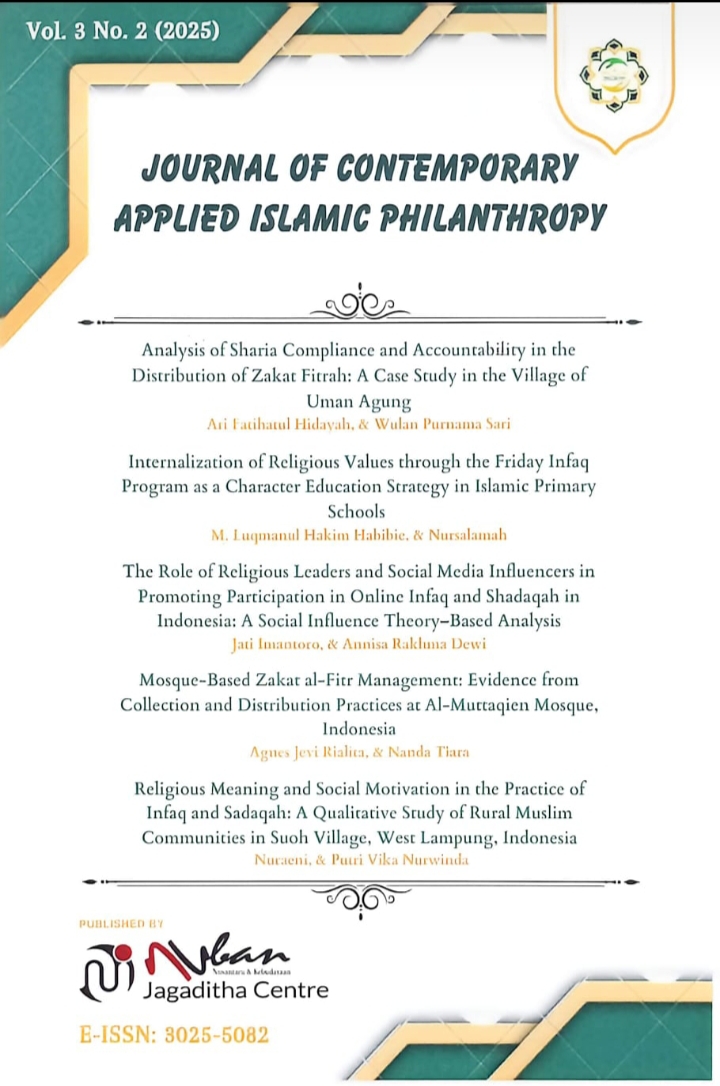
The Role of Religious Leaders and Social Media Influencers in Promoting Participation in Online Infaq and Shadaqah in Indonesia: A Social Influence Theory–Based Analysis
DOI:
https://doi.org/10.62265/jcaip.v3i2.135Keywords:
Digital Era; Media Influencers; Online Giving; Religious Leaders; Social Media Influencers.Abstract
Purpose: The digital era has brought profound transformations across various aspects of social life, including religious practices. This article aims to examine the role of religious leaders and social media influencers in promoting public participation in online infaq and shadaqah. Methodology: Employing a literature-based approach combined with qualitative analysis of relevant scholarly sources, this study identifies key strategies, challenges, and collaborative potentials between religious leaders and influencers in leveraging digital platforms for philanthropic purposes. The article underscores content engagement, transparency, and accessibility as key drivers of sustained participation in online donation platforms. Findings: The findings offer valuable insights for religious organizations and online donation platforms in designing effective strategies to enhance digital philanthropy in Indonesia. From a theoretical perspective, this article draws on Social Influence Theory to explain how the religious authority of clerics and the digital popularity of influencers function as agents of social influence in shaping public attitudes and donation behaviors. The main findings indicate that the internalization of digital philanthropic values occurs through a combination of normative authority, social identification, and symbolic persuasion mediated by digital platforms. This study enriches Islamic philanthropy scholarship by emphasizing social actors as key components of the digital donation ecosystem.
References
Ardianto, E., Komala, L., & Karlinah, N. 2007. Metode Penelitian Komunikasi. Bandung: Simbiosa Rekatama Media.
Azra, A. 2006. Islam di Asia Tenggara: Jaringan Transnasional dan Transformasi Lokal. Jakarta: Mizan.
Bungin, M. B. 2007. Metodologi Penelitian Kualitatif. Jakarta: Rajawali Pers.
Cialdini, R. B. 2007. Influence: The Psychology of Persuasion. New York: HarperCollins.
Hidayanto, A. N., dkk. 2022. Aksi Sosial Di Internet: Peran Social Media InfluencerSebagai Aktor Dalam Crowdfunding Di Media Sosial. Jurnal Sosiologi. Vol 19 (3). https://doi.org/10.31599/77rf2s68.
Nugraha, A., & Fauzia, A. 2021. Perilaku Donasi Online di Kalangan Generasi Milenial Muslim Indonesia. Jurnal Psikologi. Vol 48 (2).
Onong Uchjana Effendy. 2003. Ilmu Komunikasi: Teori dan Praktek. Bandung: Rosdakarya.
Rahmat, J. 2009. Psikologi Komunikasi. Bandung: Rosdakarya.
Rulli Nasrullah. 2015. Teori dan Riset Media Siber (Cybermedia). Jakarta: Prenada Media.
Romli, A. S. M. 2012. Analisis Isi Media: Sebuah Pengantar. Jakarta: Rajawali Pers.
Setiawan, B. 2020. Fenomena Influencer di Era Digital. Jakarta: Kompas Media.
Downloads
Published
How to Cite
Issue
Section
License
Copyright (c) 2025 Jati Imantoro, & Annisa Rakhma Dewi

This work is licensed under a Creative Commons Attribution-ShareAlike 4.0 International License.