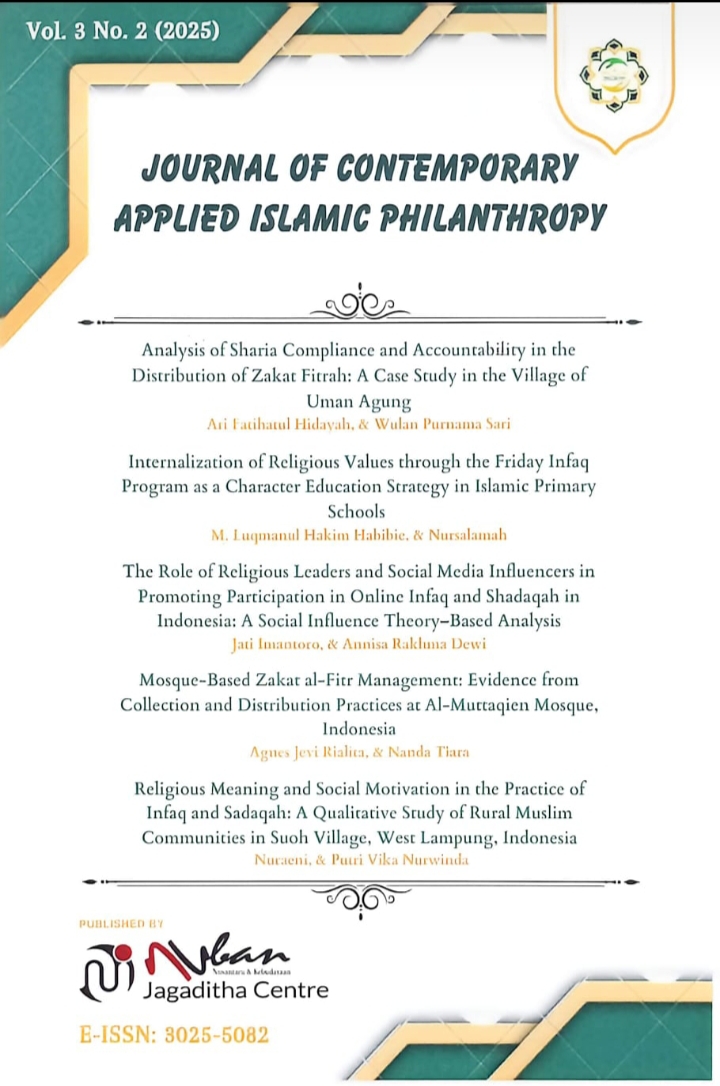
Religious Meaning and Social Motivation in the Practice of Infaq and Sadaqah: A Qualitative Study of Rural Muslim Communities in Suoh Village, West Lampung, Indonesia
DOI:
https://doi.org/10.62265/jcaip.v3i2.113Keywords:
Infaq; Religious Motivation; Rural Community; Sadaqah; Social Solidarity.Abstract
Purpose: This study aims to explore the religious meaning and social motivation underlying the practice of sedekah among rural communities in Suoh Village, Liwa, West Lampung, with a particular focus on the subjective interpretations of community members regarding charitable giving. Methodology: This research employed a qualitative approach using purposive sampling to select key informants who routinely practiced sedekah. Data were collected through in-depth interviews and analyzed using an interpretive qualitative framework. Findings: The findings reveal that sedekah is perceived as: (1) an act of worship to strengthen spiritual closeness to God, (2) a means of purifying wealth and the heart, and (3) an expression of social solidarity within the community. The primary motivations include religious faith, expectations of spiritual rewards, and empathy toward others. The main challenges identified involve limited transparency in fund management and insufficient public understanding of distinctions among Islamic charitable instruments. The novelty of this study lies in its emphasis on the subjective religious meanings and social motivations of rural community members in practicing sedekah, highlighting the role of local values and lived religious experiences in shaping philanthropic behavior. The study recommends the digitalization of financial record-keeping and the development of community-based economic empowerment programs funded through sedekah to enhance social and economic impact.
References
Ahmad, U. S. (2022). Zakat, Infak, Sedekah, Wakaf dalam Filantropi Islam. Yasin, 2(5), 749–761. https://doi.org/10.58578/yasin.v2i5.1048.
Alfiani, R. N., & Nasrulloh, N. (2022). Manajemen Pengelolaan Dana Zakat, Infaq, Dan Shodaqoh Terhadap Program Pemberdayaan Umkm Pada Lazismu Bojonegoro Management of Zakat, Infaq, and Shodaqoh Funds on Msme Empowerment Program in Lazismu Bojonegoro. Jurnal Syarikah: Jurnal Ekonomi Islam, 8(2), 312–320.
Apriliyani, S., & Malik, Z. (2021). Peran lembaga amil zakat, infaq dan shadaqah muhammadiyah (lazismu) banjarnegara dalam meningkatkan perekonomian kaum dhuafa. Jurnal Riset Ekonomi Syariah, (Query date: 2023-08-04 08:39:03). https://journals.unisba.ac.id/index.php/JRES/article/view/100.
Dan, T., Pengelolaan, A., Desa, D., & Umamur, D. (2024). Analisa Tren Pengelolaan Dana Desa 2016-2024 Transparency and Accountability in Village Fund Management: An Analysis of Trends in Village Fund Management 2016-2024. 1(2), 89–102.
Harini, N., Suhariyanto, D., Indriyani, I., Novaria, N., Santoso, A., & Yuniarti, E. (2023). Pendampingan Pemberdayaan Masyarakat dalam Meningkatkan Perekonomian Desa. Amalee: Indonesian Journal of Community Research and Engagement, 4(2), 363–375. https://doi.org/10.37680/amalee.v4i2.2834.
Khasanati, N., Sari, F., & Karfin. (2021). Motivasi Munfik Terhadap Minat Berinfak Melalui Program Penitipan Kaleng Infak Baznas Kabupaten Sorong. At-Thariqah: Jurnal Ekonomi, 2(2), 121–139.
Mas ‘Amah, F., & Panggiarti, E. K. (2023). Peran Zakat, Infak Dan Sedekah (Zis) Sebagai Kontributor Peningkatan Kesejahteraan Untuk Masyarakat Yang Membutuhkan. SENTRI: Jurnal Riset Ilmiah, 2(4), 929–939. https://doi.org/10.55681/sentri.v2i4.691.
Moleong, L. J. (2018). Metodologi Penelitian Kualitatif, Edisi Revisi Cet.36. PT Remaja Rosdakarya.
Mursyid. (2006). Mekanisme Pengumpulan Zakat, Infaq dan Shadaqah: Menurut Hukum Syara’ dan Undang-Undang (Cet. 1). Magistra Insania Press.
Sahri, T. M., & Paramita, M. (2020). Pemberdayaan Masyarakat Melalui Zakat Infaq Shadaqoh Wakaf (Ziswaf) Dalam Meningkatkan Ekonomi Masyarakat. Qardhul Hasan: Media Pengabdian Kepada Masyarakat, 6(2), 121. https://doi.org/10.30997/qh.v6i2.2016.
Sofia, Hasanah, M., & Nur, S. K. (2024). Analisis Minat dan Motivasi Berinfaq Terhadap Kesadaran Sosial Generasi Z (Studi Kasus Mahasiswa Fai Um Jember). Jurnal Pemberdayaan Ekonomi Dan Masyarakat, 1(1), 11. https://doi.org/10.47134/jpem.v1i1.117.
Suhartono, Suwandi, Tasdiq, Muhadi, & Rifa’i Mohammad. (2024). Hubungan Antara Zakat, Infak dan Sedekah dengan Nilai-nilai Sosial Masyarakat. Jurnal Pendidikan Islam, 11(2), 167–180.
Susilawati, N., & Sunarto, A. (2020). Implementasi Teknologi Informasi Berbasis Web di Badan Amil Zakat Nasional (BAZNAS). Journal of Economic, Bussines and Accounting (COSTING), 3(2), 257–266. https://doi.org/10.31539/costing.v3i2.956.
Ubabuddin, & Nasikhah, U. (2021). Peran Zakat, Infaq Dan Shadaqah Dalam Kehidupan. Jurnal Ilmiah Al-Muttaqin, 6(1), 60–76. https://doi.org/10.37567/al-muttaqin.v6i1.368.
Downloads
Published
How to Cite
Issue
Section
License
Copyright (c) 2025 Nuraeni Nuraeni, Putri Vika Nurwinda

This work is licensed under a Creative Commons Attribution-ShareAlike 4.0 International License.